How to launch employee cybersecurity campaigns
Employee cybersecurity campaigns are defined as coordinated, ongoing programmes that change staff behaviour to reduce an organisation’s exposure to digital threats. Human error contributes to 62% of confirmed data breaches, and the average cost of a single breach sits at approximately $4.44 million. Those numbers make one thing clear: technology alone does not protect an organisation. The people inside it do. Cybercompassconsulting works from this premise, integrating behavioural science with practical training to move organisations beyond compliance checklists and towards genuine culture change. The industry term for this work is a security awareness programme, and understanding how to build one well is the difference between a campaign that sticks and one that is forgotten by Friday afternoon.
How to launch employee cybersecurity campaigns: planning before you begin
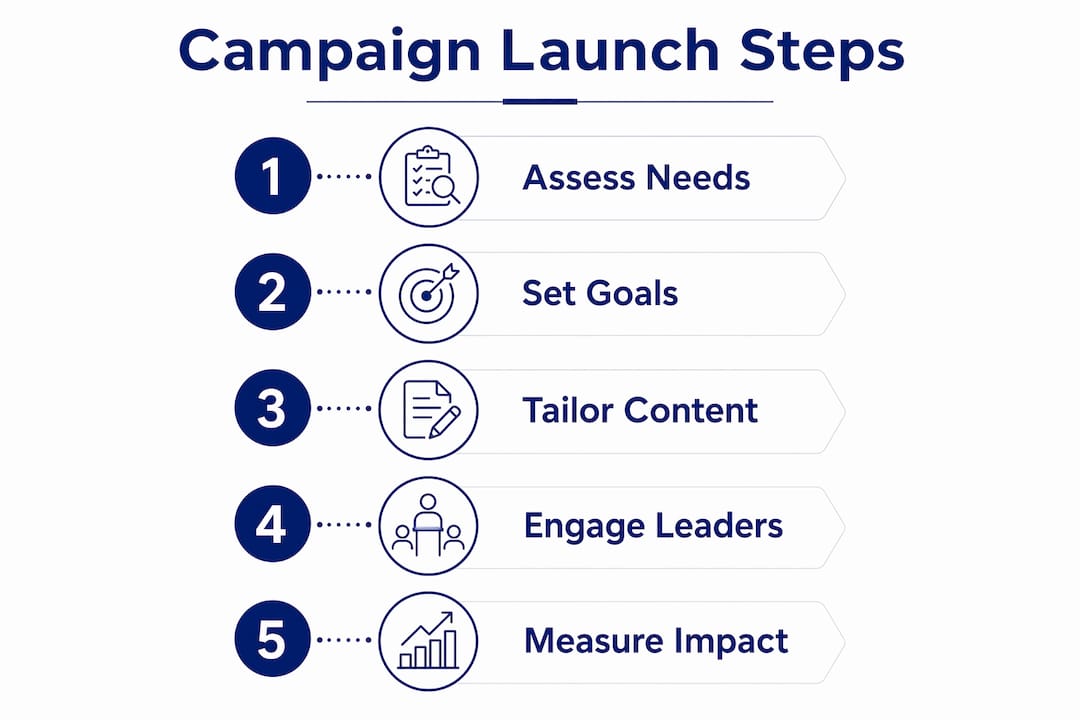
The most common reason campaigns fail is that they start with content before they start with questions. A needs assessment is the non-negotiable first step. Run a baseline phishing simulation, survey staff on their confidence with common threats, and audit your existing policies for gaps. This gives you real data rather than assumptions about where your people are most vulnerable.
From that baseline, set specific, measurable objectives. “Improve security awareness” is not a goal. “Reduce phishing simulation click-through rates by 50% within six months” is. Objectives grounded in behaviour change give you something to track and something to report to the board.
Role-specific training improves engagement and risk mitigation in ways that generic content simply cannot match. Executives face whaling attacks and business email compromise. Finance teams are targeted with invoice fraud. Frontline staff encounter credential phishing. Mapping your workforce by risk profile before you build a single module saves significant time and produces far better outcomes.

Leadership buy-in is not a nice-to-have. Visible executive engagement shifts security culture from a burden employees resent to a priority they respect. Secure a named executive sponsor before launch, and brief your senior leaders on what you are asking of them.
Prerequisite | What it involves |
Baseline phishing test | Simulated attack to measure current click-through and reporting rates |
Knowledge survey | Short questionnaire assessing staff confidence across key threat areas |
Policy audit | Review of existing acceptable use, password, and incident reporting policies |
Role risk mapping | Categorising staff by threat exposure to guide content targeting |
Executive sponsor | Named leader who actively promotes and models secure behaviour |
Which training formats actually engage employees?
The format you choose shapes how well people retain what they learn. A single annual training session is the least effective option available, yet it remains the most common approach in Australian organisations. Frequent short sessions outperform annual long sessions in both retention and behaviour change. The research is unambiguous on this point.
The most effective formats to blend into your programme include:
Microlearning modules: Five to ten minute lessons focused on a single threat or behaviour. These fit into a working day without disrupting productivity and are easy to repeat monthly.
Simulated phishing exercises: Realistic, role-relevant scenarios that test staff in real conditions. Organisations running consistent simulations reduce median click-through rates to approximately 1.5%. That figure represents a dramatic improvement from typical untrained baselines.
Live or video sessions: Best reserved for onboarding and complex topics like incident response procedures, where dialogue and questions add genuine value.
Security nudges: Monthly threat digests, brief manager reminders, and digital posters that keep awareness alive between formal training events.
Workforce geography matters here. A distributed team across multiple time zones needs asynchronous formats. A co-located team can benefit from facilitated workshops. Neither approach is universally superior. The right blend depends on your people, not on what is easiest to administer.
Pro Tip: Mixing at least three delivery formats reduces training fatigue and improves long-term retention. Vary the medium, not just the topic.
How to design content that sustains engagement over time
A campaign calendar is the backbone of any security awareness programme that lasts beyond the first quarter. Align your calendar with business cycles, compliance deadlines, and known threat peaks. Tax season, for example, brings a reliable surge in phishing attempts targeting finance teams. Your content should anticipate that.
The core content themes that every corporate programme needs to address are:
Phishing and social engineering: The most common entry point for breaches, requiring regular simulation and coaching.
Password hygiene and multi-factor authentication: Practical habits that reduce credential theft risk significantly.
Device security: Safe use of personal and corporate devices, particularly for remote workers.
Incident reporting: How and when to report a suspected threat, without fear of blame.
Data handling: Classification, storage, and sharing practices that protect sensitive information.
Storytelling makes content memorable in a way that compliance language never does. Real incident examples, even anonymised ones drawn from your own organisation’s near-misses, create relevance that generic scenarios cannot. When staff recognise the situation, they remember the lesson.
Avoid punitive reactions to simulation failures. A staff member who clicks a simulated phishing link and receives a shaming message is less likely to report a real incident later. Use failures as immediate, private coaching moments. The goal is learning, not punishment.
Pro Tip: Embed security behaviours into daily workflows rather than treating them as separate tasks. One-click phishing reporting buttons and managed password managers reduce friction and increase adoption without requiring extra effort from staff.
How do you measure whether your campaign is working?
Measurement is where most campaigns lose discipline. Tracking completion rates tells you who sat through a module. It tells you nothing about whether behaviour changed. The metrics that actually matter are behavioural.
Track these indicators consistently:
Phishing simulation click-through rates: Your primary leading indicator. Benchmarking phishing vulnerability rates over time focuses resources and demonstrates campaign effectiveness to leadership.
Phishing reporting rates: The percentage of staff who report a simulated or real suspicious email. Rising reporting rates signal a healthy security culture.
Help desk ticket trends: A reduction in password reset requests and malware incidents suggests behaviour change is taking hold.
Training completion rates: Useful as a baseline hygiene metric, but never as a proxy for effectiveness.
Employee confidence scores: Short pulse surveys measuring how confident staff feel handling specific threats reveal gaps that completion data misses entirely.
Qualitative feedback matters too. A brief survey after each training cycle tells you whether content felt relevant, whether the format worked, and what staff actually want to learn more about. That feedback loop is how you refine content rather than repeat it.
Measurement method | What it reveals |
Phishing simulation click rate | Susceptibility to social engineering attacks |
Phishing reporting rate | Willingness to flag threats and security culture health |
Help desk ticket volume | Downstream impact of training on real incident frequency |
Confidence pulse survey | Self-assessed readiness to handle common threats |
Training completion rate | Programme reach, not behaviour change |
Benchmark every metric against your pre-campaign baseline. Without that starting point, you cannot demonstrate progress, and you cannot make the case for continued investment.
Key takeaways
Effective employee cybersecurity campaigns require a structured cycle of needs assessment, role-based content, frequent delivery, and behavioural measurement to produce lasting risk reduction.
Point | Details |
Start with a baseline assessment | Run phishing simulations and knowledge surveys before building any content. |
Target content by role | Executives, finance teams, and frontline staff face different threats and need different training. |
Prioritise frequency over length | Monthly microlearning and quarterly refreshers outperform annual sessions in behaviour change. |
Measure behaviour, not completion | Track phishing click rates and reporting behaviour rather than module completion alone. |
Make leadership visible | Executive sponsorship shifts security from an IT burden to an organisational priority. |
What I have learned from watching campaigns succeed and fail
I have seen organisations invest significantly in cybersecurity training and still experience preventable breaches. The pattern is almost always the same. The training was technically sound. The content covered the right topics. But it ran once a year, leadership treated it as an IT matter, and staff completed it the way they complete any compliance task: as quickly as possible, with as little attention as possible.
The campaigns that genuinely change behaviour share a different quality. They feel like part of the organisation’s culture rather than an imposition on it. Security awareness built as a continuous culture lowers risk in ways that periodic training simply cannot replicate. That shift does not happen through better slide decks. It happens when leaders talk about security in all-hands meetings, when managers check in after a phishing simulation, and when reporting a near-miss is celebrated rather than scrutinised.
The other thing I would push back on is the instinct to make campaigns comprehensive from day one. You do not need to cover every threat in the first month. Start with the highest-risk behaviours for your specific workforce, get those right, and build from there. Trying to address everything at once produces shallow coverage of everything and deep understanding of nothing.
Role-based content is not a luxury for large organisations. Even a team of thirty people contains meaningfully different risk profiles. The person who approves payments needs different training from the person who manages your social media accounts. Treating them identically wastes both their time and yours. For practical guidance on reducing human error through targeted campaigns, the specifics matter far more than the volume of content delivered.
— Jemma
Cybercompassconsulting’s approach to building campaigns that last
Cybercompassconsulting works with corporate teams to design and deliver cybersecurity awareness programmes grounded in behavioural science, not just compliance requirements. The focus is on practical assessment, role-based content, and the kind of ongoing reinforcement that actually changes what people do when a threat lands in their inbox.
If your organisation is ready to move beyond annual checkbox training, Cybercompassconsulting’s corporate cyber safety services offer tailored programmes built around your workforce’s specific risk profile. From baseline assessment through to campaign measurement, the team brings over 35 years of experience in cyber wellness and human behaviour to every engagement. You can also explore the full range of awareness and training services or book a consultation to discuss your organisation’s needs directly.
FAQ
What is an employee cybersecurity awareness campaign?
An employee cybersecurity awareness campaign is a structured programme that uses training, simulations, and ongoing communication to change staff behaviour and reduce an organisation’s exposure to digital threats. It differs from one-off compliance training by running continuously throughout the year.
How often should cybersecurity training run?
Best-practice schedules include onboarding training, monthly phishing simulations with microlearning, quarterly refreshers, and an annual comprehensive review. Monthly touchpoints produce significantly better retention than annual sessions alone.
What metrics show a cybersecurity campaign is working?
Phishing simulation click-through rates and staff reporting rates are the most reliable behavioural indicators. Completion rates measure reach but do not confirm that behaviour has changed.
How do you get leadership involved in a security campaign?
Secure a named executive sponsor before launch and brief leaders on the specific behaviours you need them to model. Active leadership promotion shifts security from an IT obligation to an organisational value.
Does role-based training make a measurable difference?
Role-specific content improves engagement and reduces risk more effectively than generic training. Executives require targeted content on threats like whaling, while general staff benefit most from phishing recognition and good cyber hygiene practices.
Recommended
Comments