Types of cyberthreat simulations for education: 2026 guide
Cyberthreat simulations are controlled exercises that mimic real cyberattacks in a safe, structured environment to build practical digital safety skills. The types of cyberthreat simulations used in education range from immersive virtual reality environments to gamified Capture-the-Flag challenges and AI-driven adaptive training, each with distinct benefits for different student groups. Research published in 2026 shows VR-based training produces a 32% average gain in post-training test scores. That figure alone makes a compelling case for moving beyond worksheets and lectures. Cybercompassconsulting works with schools to match the right simulation type to curriculum goals, student age groups, and available resources.
1. What are the main types of cyberthreat simulations in education?
Cybersecurity simulation exercises in schools fall into four broad categories: immersive VR simulations, Capture-the-Flag competitions, AI-driven adaptive training, and scenario-based drills. Each category targets different skills and suits different budgets. Understanding the differences helps educators choose methods that fit their students rather than forcing every class through the same generic programme. The goal is always the same: students who can recognise, respond to, and recover from real cyber threats.
2. Immersive VR cyberthreat simulations
VR simulations place students inside a virtual environment that replicates a real cyberattack scenario. A student might find themselves inside a simulated hospital network watching ransomware spread in real time, or defending a school server from a phishing intrusion. The experience is visceral in a way that a slideshow simply cannot replicate.
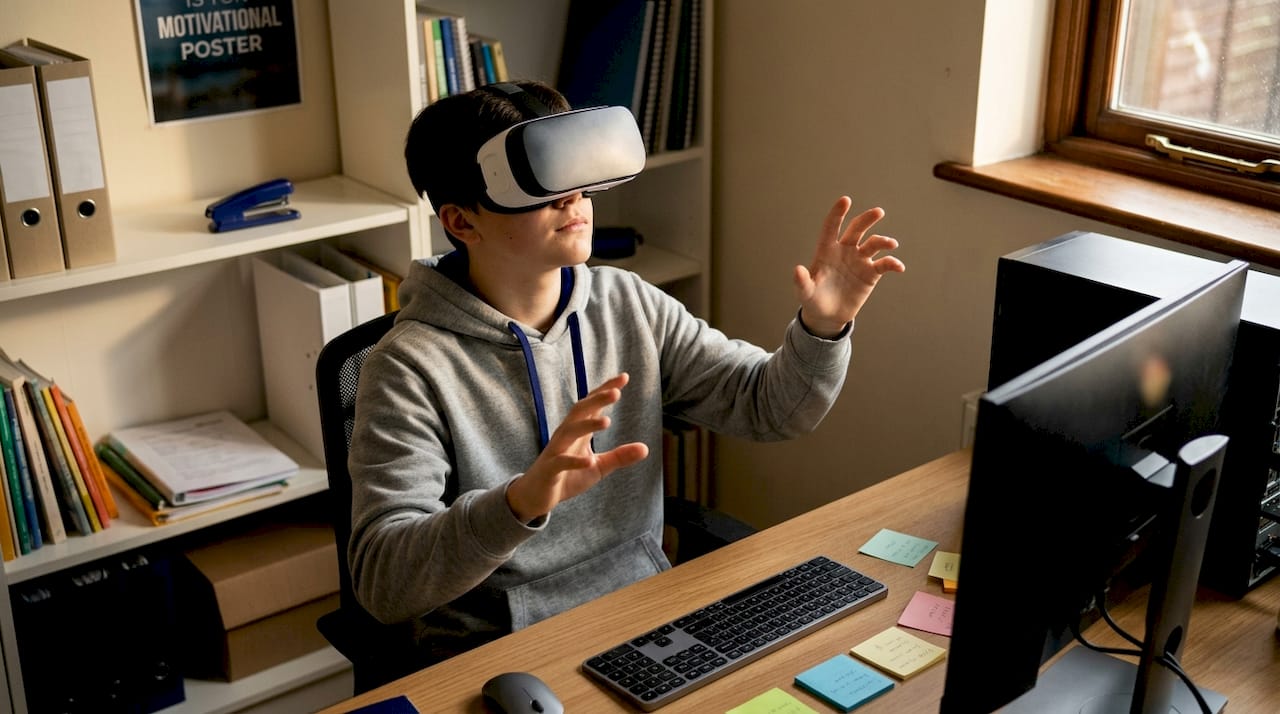
The evidence backs this up. VR-based cybersecurity training achieves a 32% average improvement in post-training test scores, with machine learning models classifying user risk at up to 91% accuracy using XGBoost. That classification capability means educators can identify which students carry the highest risk behaviours and target follow-up support precisely.
Key benefits of VR simulations for schools include:
Realistic threat scenarios that build genuine risk recognition
Behavioural analytics that personalise the training path for each student
High engagement, particularly for visual and kinaesthetic learners
Measurable pre- and post-training assessment built into the platform
The honest challenge is cost. Full immersive VR headsets and licences are expensive at scale. However, Desktop VR offers a cost-effective and scalable alternative that preserves most of the knowledge retention benefits without the hardware overhead.
Pro Tip: Start with Desktop VR for whole-class deployment, then reserve full immersive headsets for small-group deep dives with students who need the most intensive intervention.
3. How do Capture-the-Flag exercises support cybersecurity skills?
Capture-the-Flag (CTF) exercises are competitive, challenge-based simulations where students solve cybersecurity puzzles to “capture” digital flags. Each puzzle mirrors a real attack or defence scenario, from cracking weak passwords to identifying SQL injection vulnerabilities. The competitive format turns abstract concepts into something students genuinely want to win.
The CipherQuest CTF platform improved cybersecurity skills in 90% of participants through curriculum-aligned challenges with real-time feedback. That is not a marginal gain. It reflects what happens when learning feels like a game with real stakes rather than a compliance checkbox.
CTF platforms work best in schools when they are:
Aligned to existing digital technologies or IT curriculum outcomes
Structured with progressive difficulty so beginners are not immediately overwhelmed
Supported by robust user management so teachers can track individual progress
Paired with debrief sessions where students discuss what they learned from each challenge
One important nuance: students in simulated vulnerability environments achieve 79.33% success exploiting vulnerabilities but only 65.33% success applying secure coding solutions. Offensive skills come more naturally than defensive ones. CTF design needs to deliberately weight defensive challenges to close that gap.
Pro Tip: Map each CTF challenge to a specific curriculum outcome before the event. Students who understand why a challenge matters retain the skill far longer than those who treat it as a standalone game.
4. What are AI-driven adaptive cyberthreat training methods?
AI-driven adaptive training adjusts the difficulty and content of each simulation in real time based on how a student is performing. If a student breezes through basic phishing recognition, the system escalates to spear-phishing scenarios with contextual social engineering cues. If a student struggles, the system slows down and reinforces foundational concepts before moving on.
The results are striking. AI-driven adaptive training produces statistically significant improvements in phishing detection accuracy, with an effect size of Cohen’s d=1.47 (p<0.001), and sustains knowledge retention over two weeks. An effect size above 0.8 is considered large in educational research. At 1.47, this is exceptional.
Traditional cybersecurity awareness training often fails to produce sustained behavioural change without this kind of personalisation. That is the core problem with one-size-fits-all approaches: they teach to the average student and leave both ends of the ability spectrum behind.
AI adaptive platforms also integrate real-time threat intelligence, meaning the scenarios students face reflect current attack methods rather than threats from five years ago. For educators, this removes the burden of constantly updating training content manually.
Pro Tip: When selecting an adaptive platform for a school setting, prioritise those with teacher-facing dashboards that show individual student risk profiles. The data is only useful if you can act on it.
5. Scenario-based drills and cyber range exercises
Scenario-based drills are structured simulations where students take on defined roles, such as incident responder, network analyst, or communications officer, during a simulated cyber incident. Cyber ranges extend this further by creating a full virtual network environment where multiple teams operate simultaneously.
Multi-layered cyber range architecture using Red (attacker), Blue (defender), and White (referee) teams produces a Learning Gain Index above 0.6, which represents meaningful educational progress. The Red/Blue/White structure mirrors professional incident response, giving students a realistic sense of how organisations actually respond to breaches.
Narrative-driven simulations, such as defending a solar monitoring system from a cyberattack, improve engagement and ethical reasoning for non-technical students. The narrative context makes abstract threats concrete and personal. Students are not just solving a puzzle; they are protecting something that matters.
6. Comparing educational cyberthreat simulation types
Simulation type | Realism | Cost | Scalability | Technical complexity | Student engagement |
Immersive VR | Very high | High | Low to medium | High | Very high |
Desktop VR | High | Medium | High | Medium | High |
Capture-the-Flag | Medium to high | Low to medium | High | Medium | Very high |
AI adaptive training | High | Medium | Very high | Low (for students) | High |
Scenario-based drills | Medium | Low | Medium | Low to medium | Medium to high |
Cyber range (Red/Blue/White) | Very high | High | Low | Very high | High |
The right choice depends on your school’s budget, technical infrastructure, and student cohort. Smaller schools with limited IT support tend to get the best results from CTF platforms and AI adaptive tools. Larger institutions with dedicated IT staff can run full cyber range exercises effectively.
7. Best practices for implementing cyberthreat simulations in schools
Effective implementation requires more than purchasing a platform and hoping for the best. These practices make the difference between a simulation that changes behaviour and one that students forget by Friday.
Align simulations to curriculum outcomes. Every simulation activity should map to a specific learning objective in your digital technologies or health and wellbeing curriculum. This justifies the time investment and makes assessment straightforward.
Balance offensive and defensive activities. Students naturally gravitate toward attack scenarios. Deliberately include defensive challenges to build the protective instincts that matter most in real life.
Use ongoing assessment, not just pre and post tests. Build feedback loops into every session. Students who receive immediate feedback on their decisions retain skills significantly longer than those who wait for a summary report.
Leverage progress tracking tools. Institution-grade platforms with user management let you monitor individual student development over time and identify those who need additional support. Cybercompassconsulting recommends platforms with teacher-facing analytics as a non-negotiable feature.
Scale gradually. Start with a single year group or elective class before rolling out school-wide. Lessons learned in a pilot protect the broader programme from avoidable failures.
Include all skill levels. Design entry points that do not require prior coding knowledge. Narrative-driven scenarios are particularly effective for engaging students who do not identify as technical.
Pro Tip: Run a brief debrief circle after every simulation session. Students who articulate what they learned out loud consolidate that knowledge far more effectively than those who simply move on to the next task.
A student cyber awareness workflow that integrates simulation with classroom discussion and real-world application produces the most durable behaviour change.
Key takeaways
The most effective cyberthreat simulations for schools combine immersive, adaptive, and gamified approaches to build lasting digital safety skills across all student ability levels.
Point | Details |
VR simulations produce measurable gains | A 32% average test score improvement makes VR one of the strongest simulation formats available. |
CTF exercises build practical skills fast | 90% of participants improve cybersecurity skills through well-designed, curriculum-aligned CTF challenges. |
AI adaptive training sustains retention | An effect size of Cohen’s d=1.47 shows AI-driven personalisation outperforms traditional training significantly. |
Defensive skills need deliberate focus | Students exploit vulnerabilities more easily than they apply secure solutions, so defensive challenges must be weighted intentionally. |
Implementation quality determines outcomes | Curriculum alignment, feedback loops, and inclusive design matter as much as the simulation platform itself. |
Why I think schools are still underestimating simulation-based learning
I have worked with school communities long enough to see a pattern. Administrators approve a cybersecurity awareness programme, teachers deliver it once a year, and everyone ticks the compliance box. Then a student clicks a phishing link in week two of term and the whole exercise feels pointless.
The research is clear that sustained behavioural change requires personalised, repeated exposure, not a single annual session. What I find genuinely exciting about the current generation of simulation tools is that they make this possible without requiring a full-time cybersecurity teacher on staff. An AI adaptive platform can do the heavy lifting of personalisation. A well-designed CTF can run with minimal teacher facilitation once it is set up.
The gap I see most often is not resources. It is confidence. Educators worry they do not know enough about cybersecurity to run these programmes credibly. That concern is understandable, but it misses the point. You do not need to know how to hack a network to facilitate a simulation. You need to know your students, understand the learning objectives, and trust the platform to handle the technical complexity. That is exactly the kind of support Cybercompassconsulting provides to schools: not just the tools, but the confidence to use them well.
— Jemma
How Cybercompassconsulting supports schools with simulation education
Schools that want to move beyond awareness posters and annual talks have a practical path forward.
Cybercompassconsulting brings over 35 years of experience in cyber wellness to school communities across Australia. The Cyber Wellness School Program offers virtual consultations that help educators identify the right simulation types for their curriculum, student cohort, and budget. From CTF integration to AI adaptive platform selection, the programme provides hands-on guidance at every stage. Schools can also access tailored cyber safety services that combine behavioural science with practical simulation design. Book a consultation online and take the first concrete step toward a school culture where digital safety is practised, not just taught.
FAQ
What is cyber threat simulation for schools?
Cyber threat simulation for schools is a controlled exercise that replicates real cyberattacks in a safe environment to teach students how to recognise and respond to digital threats. Formats include VR environments, Capture-the-Flag competitions, and AI-driven adaptive training.
Which simulation type works best for non-technical students?
Narrative-driven scenario simulations and CTF platforms with progressive difficulty work best for non-technical students, as they provide context and accessible entry points without requiring prior coding knowledge.
How often should schools run cybersecurity simulation exercises?
Schools should integrate simulation exercises throughout the year rather than in a single annual session. Repeated, spaced exposure is what produces lasting behaviour change, particularly when paired with real-time feedback.
Are AI-driven adaptive platforms suitable for secondary schools?
AI-driven adaptive platforms are well-suited to secondary schools because they adjust difficulty automatically to each student’s level. Research shows they produce a Cohen’s d effect size of 1.47 in phishing detection improvement, with retention sustained over two weeks.
How do educators measure the success of cyberthreat simulations?
Educators measure success through pre and post-training test scores, behavioural analytics from the platform, and ongoing assessment of student decision-making in simulated scenarios. A Learning Gain Index above 0.6 is considered a strong outcome in cyber range exercises.
Recommended
Comments