What is phishing awareness and why it matters
Phishing awareness is defined as the ability to recognise and respond to deceptive digital messages designed to trick you into revealing sensitive information or installing malware. These attacks arrive through emails, SMS, phone calls, and now AI-powered deepfake video calls. For families, the stakes are personal. A single convincing message can expose bank details, passwords, or a child’s identity. Understanding what phishing awareness means is the first step toward protecting the people you care about most.
What is phishing awareness and how does it protect you?
Phishing awareness is the practice of knowing what a fraudulent message looks like, understanding why it works, and knowing what to do when you see one. It sits at the intersection of knowledge and behaviour. Knowing that phishing exists is not enough. You need to act differently because of that knowledge.
Phishing is the leading cause of data breaches globally. It bypasses firewalls and antivirus software by targeting human behaviour instead of technical systems. That means no amount of software alone will protect your family if no one in the household knows how to spot a suspicious message.

The importance of phishing awareness grows every year as attackers become more sophisticated. AI tools now allow criminals to clone voices, mimic writing styles, and generate fake video calls that look real. Phishing education is no longer a corporate concern. It belongs in every home.
What are the common forms and psychological tactics of phishing?
Phishing takes many shapes. Attackers choose their method based on who they are targeting and what they want to steal.
The main types include:
Email phishing. The most common form. A message appears to come from a trusted sender like your bank, Australia Post, or the ATO, asking you to click a link or open an attachment.
Spear phishing. A targeted attack using personal details to make the message feel legitimate. Your name, employer, or recent purchase might appear in the message.
Smishing. Phishing via SMS. A text message claims your parcel is held, your account is locked, or you owe a fine.
Vishing. Voice phishing via phone call. A caller pretends to be from the ATO, a bank, or a tech support team.
Whaling. Attacks aimed at high-value targets like business owners or executives, often involving large financial transfers.
What makes these attacks effective is not technical sophistication. It is psychology. Phishing messages exploit urgency, fear, authority, and curiosity. A message saying “Your account will be suspended in one hour” triggers panic. Panic short-circuits careful thinking. That is exactly what attackers count on.
Attackers increasingly use AI to create highly convincing scams that mimic trusted entities. A deepfake video call from someone who looks and sounds like your bank manager is no longer science fiction. It is a documented attack method. Phishing education must keep pace with these developments.
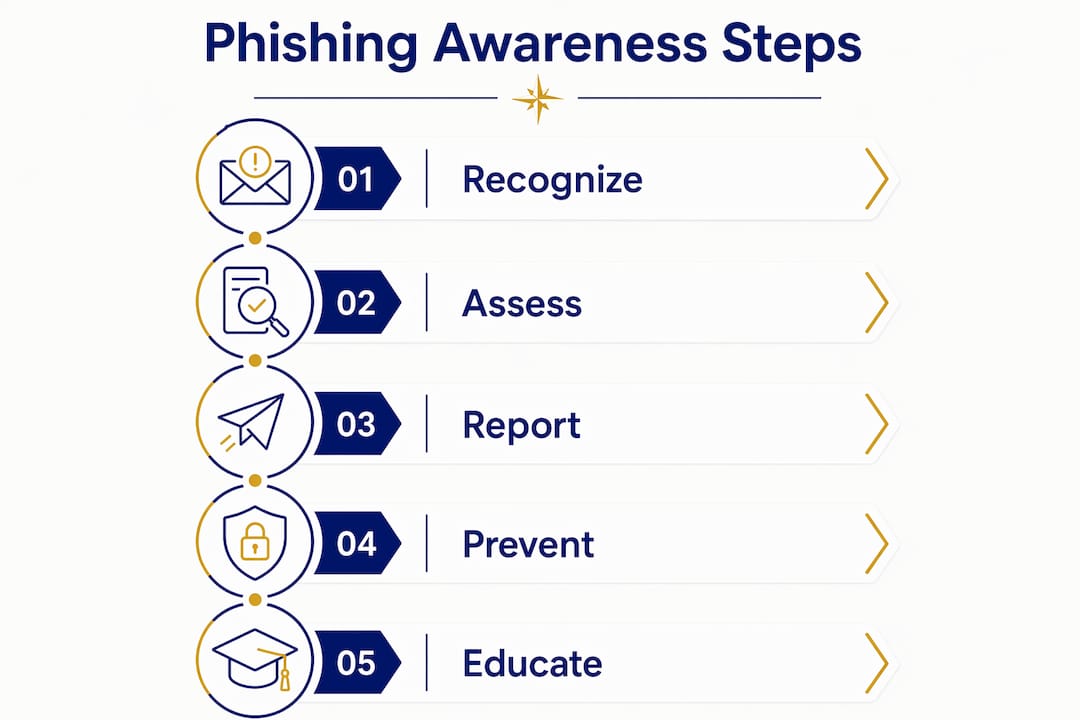
What are the key indicators of a phishing attempt?
Phishing messages share common characteristics. Learning to spot them takes practice, but the red flags are consistent.
Watch for these warning signs:
Generic greetings. “Dear Customer” or “Dear User” instead of your actual name.
Suspicious sender addresses. The display name looks right, but the actual email domain is wrong. “support@amaz0n-help.net” is not Amazon.
Unexpected links or attachments. Any message urging you to click a link or open a file you were not expecting deserves suspicion.
Poor grammar or unusual phrasing. Legitimate organisations proofread their communications. Errors signal something is off.
Urgent demands. Threats of account closure, legal action, or missed deliveries are designed to rush your decision.
Mismatched URLs. Hover over any link before clicking. If the address shown does not match the organisation’s real domain, do not click.
Phishing attempts can include spoofed QR codes, fake login pages, and urgent claims from supposed government or bank officials. Unexpected attachments are frequent carriers of malware. Treat any unsolicited attachment as a threat until proven otherwise.
Always verify the full domain of suspicious senders or links before clicking. On a phone, press and hold a link to preview the URL. On a desktop, hover your cursor over it. A legitimate bank will never send you to a domain you do not recognise.
Pro Tip: If a message creates a strong emotional reaction, such as fear, excitement, or urgency, pause for thirty seconds before doing anything. That pause is your best defence. Attackers engineer emotion to bypass your judgement.
A subtler red flag many people miss is the reply-to address. The “from” address might look legitimate, but the reply-to field routes your response to an attacker’s inbox. Check both fields before responding to any sensitive request.
How does effective phishing awareness training work?
Phishing awareness training is most effective when it changes behaviour, not just knowledge. Reading a list of red flags once does not make you safer. Repeated, realistic exposure does.
Here is how good training works in practice:
Simulate real attacks safely. Sending test phishing emails to household members or employees, with immediate feedback when someone clicks, builds recognition skills faster than any classroom lesson.
Make reporting easy. Employees who report suspicious messages promptly provide real-time threat intelligence that stops attacks from spreading. The same principle applies at home. If your child sees a suspicious message, they need to feel safe telling you without fear of judgement.
Measure behaviour, not just clicks. Effective training prioritises measuring behaviour change over click rates. How quickly does someone report? Do they pause before clicking? These habits matter more than a test score.
Keep it ongoing. A single training session fades within weeks. Regular, short reminders outperform annual workshops. A five-minute conversation at dinner about a phishing story in the news is legitimate training.
Reduce friction in reporting. If reporting takes too long or feels pointless, people stop reporting. A simple “forward this to me” system within a family works. In a workplace, a one-click reporting button makes the difference.
The importance of phishing awareness training extends well beyond the office. Families are targets too. Children receive phishing messages through gaming platforms, social media, and messaging apps. Parents who build open conversations about suspicious messages create a household culture of digital safety. That culture is far more protective than any single piece of software.
Building secure digital habits alongside awareness training compounds the protection. Habits automate safe behaviour so you do not have to rely on vigilance alone.
What practical steps can you take to improve phishing protection?
Practical protection starts with a few consistent habits. These steps work for individuals and families alike.
Pausing before clicking, verifying URLs, not sharing passwords, and enabling multifactor authentication reduce phishing risks substantially. Multifactor authentication means that even if an attacker steals your password, they cannot access your account without a second verification step. Enable it on every account that offers it, starting with email and banking.
The table below compares key protective steps and their practical impact:
Protective step | What it does for you |
Pause before clicking any link | Breaks the urgency loop attackers rely on |
Verify sender domain manually | Catches spoofed addresses before you engage |
Enable multifactor authentication | Blocks account access even if your password is stolen |
Report suspicious messages | Alerts others and helps security teams act fast |
Use a password manager | Prevents credential reuse across sites |
Reporting suspicious messages matters more than most people realise. When you forward a phishing SMS to 0476 MATILDA (the Australian Cyber Security Centre’s reporting number) or report a phishing email to your provider, you help protect others. Collective reporting is how phishing campaigns get shut down.
For families, the conversation is as important as the tools. Teach children that it is always safe to ask a parent before clicking anything unexpected. Remove the shame from mistakes. A child who clicked a suspicious link and tells you immediately is far safer than one who hides it out of fear.
Pro Tip: Set up a shared family rule: before clicking any link in a message, ask yourself three questions. Do I know this sender? Was I expecting this message? Does this link match the sender’s real website? If any answer is no, do not click.
Checking online risks for kids regularly keeps you informed about the specific tactics targeting children, which differ from those targeting adults.
Key takeaways
Phishing awareness requires recognising the psychological tactics behind attacks, knowing the red flags, and building consistent reporting habits that protect both individuals and families.
Point | Details |
Phishing targets behaviour | Technical tools alone cannot protect you; human awareness is the critical layer. |
Psychological triggers drive success | Urgency, fear, and authority are the tools attackers use most. Pause when you feel them. |
Red flags are consistent | Generic greetings, mismatched URLs, and unexpected attachments appear in most phishing messages. |
Reporting is a protective act | Reporting suspicious messages quickly stops attacks from spreading to others. |
Families need training too | Children receive phishing attempts through gaming and social platforms, not just email. |
Why phishing awareness is harder than it looks
I have spent years working with families and organisations on cyber safety, and the pattern I see most often surprises people. The individuals who fall for phishing are not careless or uninformed. They are busy. They are distracted. They are managing three things at once when a convincing message arrives, and their brain takes the shortcut.
People fail phishing tests not because they lack information but because distractions and time pressure affect decision-making. That insight changed how I think about phishing education entirely. The goal is not to make people smarter. It is to make safe behaviour easier than unsafe behaviour.
What I advocate for is building a culture of “it’s okay to ask.” In families, that means a child who receives a weird message on their gaming account should feel completely comfortable saying, “Mum, can you look at this?” In workplaces, it means a staff member who clicks something suspicious should report it immediately without fear of embarrassment. Shame is the enemy of security.
The technology will keep evolving. Deepfakes will get better. AI-generated messages will become harder to distinguish from real ones. The best protection is not a smarter filter. It is a household or team that talks openly about what they see online and reports anything that feels off. That habit, built consistently, is worth more than any software subscription.
— Jemma
How Cybercompassconsulting supports families with cyber safety
Cybercompassconsulting works with families, schools, and organisations to build genuine cyber safety culture, not just compliance checklists. The approach combines behavioural science with practical education, so awareness becomes a lasting habit rather than a one-off lesson.
If you want personalised support for your family’s digital safety, including phishing awareness and broader online protection, Cybercompassconsulting offers family-focused cyber safety programmes and virtual consultations. For a full picture of what is available, visit the services page and find the right fit for your household or organisation.
FAQ
What is phishing awareness in simple terms?
Phishing awareness is the ability to recognise a fraudulent message designed to steal your information or install malware, and to respond safely by not clicking, reporting it, and verifying the sender.
Why is phishing awareness important for families?
Phishing targets everyone, including children through gaming platforms and social media. Families that talk openly about suspicious messages and report them quickly are far less likely to fall victim.
What are the most common signs of a phishing message?
The most consistent red flags are generic greetings, mismatched sender domains, unexpected links or attachments, urgent demands, and poor grammar. Always verify the full URL before clicking any link.
How does phishing awareness training work for individuals?
Good training combines realistic simulated attacks with immediate feedback, easy reporting, and regular short reminders. A single session is not enough. Ongoing practice builds the habits that protect you under pressure.
What should you do if you think you received a phishing message?
Do not click any links or open attachments. Report the message to your email provider, forward suspicious SMS to the Australian Cyber Security Centre, and alert anyone else who may have received the same message.
Recommended
Comments