Why digital wellbeing matters: guide for families and educators
What is digital wellbeing and why does it matter?
Digital wellbeing is the state of maintaining a healthy, intentional relationship with technology so that it supports rather than undermines your mental, physical, and emotional health. The International Telecommunication Union defines it as balancing technology use so it empowers rather than stresses, shaped by how individuals perceive themselves, their digital environment, and the influences technology exerts on their lives.
Why is digital wellbeing important? Because the alternative is not neutral. Unchecked technology use quietly erodes concentration, sleep, emotional stability, and real-world relationships. Most people do not notice the erosion until it has already cost them something.
The good news is that digital wellbeing is not about giving up your phone or logging off permanently. It is about conscious engagement: choosing when, how, and why you use technology, so that it works for you rather than against you.
Key benefits of prioritising digital wellbeing:
Reduced anxiety and emotional fatigue from constant connectivity
Improved sleep quality by limiting screen exposure before bed
Stronger focus and productivity during work or study
Healthier relationships, both online and in person
Greater resilience against online scams, misinformation, and cyberbullying
Better physical health through reduced sedentary screen time
Why digital wellbeing matters more than ever right now
We are living through a period of genuinely unprecedented screen saturation. Nearly 70% of office workers spend more than seven hours a day on screens, and the average person now spends six hours and 38 minutes online every day, roughly 42% of their waking hours. That is not a lifestyle choice for most people. It is the architecture of modern work, education, and social life.
The economic cost of ignoring this is staggering. Symptoms of excessive screen time cost the US an estimated $73 billion per year in lost productivity and wellbeing. Australia faces comparable pressures, with digital burnout increasingly cited in workplace absenteeism and mental health claims.
62% of US adults experience digital burnout either occasionally or regularly, while nearly a third admit they rarely or never intentionally unplug.
The pressure compounds at work. Nearly 33% of workers are interrupted by a digital workplace notification every 15 minutes, adding up to more than 160 digital distractions per workday. That is not a productivity culture. That is a fragmentation culture, and it takes a real toll on mental resilience.
Key reasons digital wellbeing supports modern life:
Protects cognitive capacity by reducing constant context-switching
Supports work-life balance, which 83% of workers globally now rank as their top job priority, above pay
Reduces technostress and the chronic low-grade anxiety of always-on connectivity
Builds the mental stamina needed to engage meaningfully with AI-assisted work environments
Helps families and schools model healthy digital habits for children
How digital wellbeing affects your mental, physical, and emotional health
Excessive technology use correlates with anxiety, depression, and poor academic and work outcomes. That connection is well-established in the research literature. What gets less attention is the reverse: good digital wellbeing actively enhances engagement, communication, and productivity. The relationship runs both ways.
Mentally, the damage from overuse tends to be cumulative and quiet. Constant notifications fragment attention. Algorithmically served content, particularly on social media, is designed to provoke emotional reactions, which means your nervous system is being stimulated far more than it would be in ordinary daily life. Over time, this raises baseline anxiety and makes it harder to concentrate on anything that does not deliver an instant reward.

Physically, the effects are more visible. Eye strain, neck and back pain from poor posture, and disrupted sleep are the most common complaints. Children are particularly vulnerable to sedentary screen habits that displace physical activity during critical developmental windows.
Emotionally, the picture is more nuanced. Technology can genuinely strengthen social connections when used with intention. It can also hollow them out when it substitutes for real presence. Digital empathy, the capacity to engage with others online with care and consideration, is a skill that needs to be taught, especially to young people navigating social media for the first time.
Symptoms and benefits across health domains:
Mental health risks: anxiety, depression, cognitive overload, difficulty concentrating, compulsive checking
Mental health benefits: improved focus, reduced rumination, greater sense of control
Physical risks: eye strain, disrupted sleep, sedentary behaviour, headaches
Physical benefits: more movement, better sleep hygiene, reduced tension
Emotional risks: social comparison, cyberbullying exposure, emotional dysregulation
Emotional benefits: stronger real-world relationships, improved digital empathy, greater self-awareness
Common digital wellbeing challenges for individuals and families
Digital addiction is the most talked-about challenge, but it is also the most misunderstood. Most people are not clinically addicted to their devices. They are caught in habit loops that platforms have spent billions of dollars engineering. The distinction matters because it shifts responsibility: this is not purely a willpower problem.
Information overload is a quieter but equally corrosive issue. When every news cycle brings fresh urgency and every platform competes for attention, the ability to assess content quality degrades. People become reactive rather than reflective, sharing before thinking, and absorbing anxiety without context.
Cybersecurity threats add another layer. Phishing scams, identity theft, and online fraud are not just financial risks. They carry a genuine emotional toll, particularly for older Australians and children who may not recognise the warning signs. Understanding digital citizenship is part of the answer here, because safe online behaviour and digital wellbeing are inseparable.
Key challenges across age groups:
Compulsive social media checking and fear of missing out
Notification overload disrupting focus and rest
Difficulty distinguishing credible information from misinformation
Exposure to cyberbullying, harmful content, or online predators (particularly for children)
Screen time displacing sleep, physical activity, and face-to-face connection
Technostress from always-on work expectations
Children’s vulnerability to algorithmically served content that is not age-appropriate
For families, the challenge is that children are navigating these risks largely without a roadmap. Research on good versus problematic screen time for children shows that the type and context of screen use matters as much as the duration. Passive scrolling and active, creative, or educational engagement are not equivalent experiences.
Practical strategies to improve digital wellbeing every day
The most effective starting point is not an app. It is a decision about what kind of relationship you want with technology, and then designing your environment to support that decision rather than undermine it.
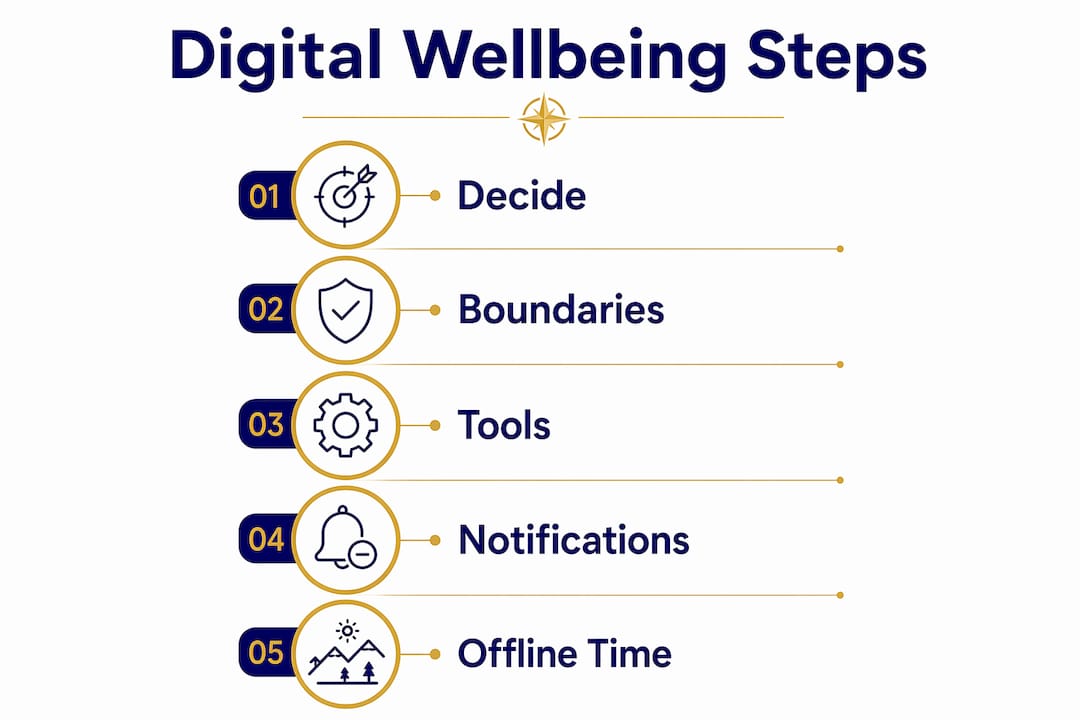
Setting intentional boundaries means being specific. “Less screen time” is not a plan. “No phone at the dinner table” and “no screens after 9:30 PM” are plans. Specificity is what makes boundaries stick, especially for children who need clear, consistent rules rather than vague guidance.
Built-in tools like Google Digital Wellbeing (available on Android devices) and iOS Screen Time (on Apple devices) give you concrete data on your usage patterns and let you set app limits, schedule downtime, and restrict content. They are not perfect solutions, but they make the invisible visible, which is a genuinely useful first step. Parents can use these tools to set boundaries for children’s devices without relying entirely on self-regulation from kids who are developmentally not yet equipped for it.

Managing notifications is underrated as a strategy. Turning off non-essential notifications reduces the number of times your attention is hijacked each day. Most people find that almost nothing they turned off actually needed to be on.
Cultivating offline time is not a luxury. Physical separation from devices, even for short periods, allows the nervous system to reset. Walking without headphones, eating without a screen, and having conversations without phones on the table are small acts with measurable effects on stress and presence.
For schools and families, digital literacy education is the long game. Teaching children to evaluate sources, recognise manipulation, and set their own boundaries builds the kind of resilience that no parental control app can replicate. Cybercompassconsulting’s cyber literacy programmes for schools take exactly this approach, embedding digital wellbeing into the school culture rather than treating it as a one-off lesson.
Practical steps to start today:
Audit your screen time using Google Digital Wellbeing or iOS Screen Time
Turn off all non-essential push notifications
Create phone-free zones at home (bedroom, dining table)
Schedule one offline period per day, even 30 minutes
Have an honest family conversation about digital habits and expectations
Teach children to pause before sharing or reacting to content online
Pro Tip: Place your phone charger outside the bedroom. This single environmental change removes the temptation to check your phone first thing in the morning and last thing at night, two of the highest-risk moments for compulsive use.
What behavioural science and cybersecurity tell us about digital wellbeing
Digital platforms are not neutral tools. They are designed to maximise engagement, often at the expense of your health and attention. Variable reward schedules, infinite scroll, and algorithmically personalised content are not accidents of design. They are deliberate features, and they work. Personal discipline alone is genuinely insufficient to counter them, which is why environmental and systemic strategies matter so much.
Workplace digital wellbeing is increasingly recognised as an organisational design challenge, not just an individual responsibility. Companies that treat it as a cultural and structural issue, rather than a personal failing, see measurable improvements in employee resilience, productivity, and retention. This means communication charters, clear norms around response times, and leadership that models healthy digital behaviour.
Digital wellbeing also aligns directly with United Nations Sustainable Development Goal 3, which focuses on ensuring healthy lives and promoting wellbeing for all. That alignment is not incidental. It reflects a growing global consensus that how we design and use technology is a public health issue, not just a personal preference.
Cybersecurity and digital wellbeing are more connected than most people realise. Emotional vulnerability, fatigue, and cognitive overload are precisely the conditions under which people fall for scams and phishing attacks. A person who is stressed, sleep-deprived, and overwhelmed by notifications is a far easier target than someone who is rested, focused, and digitally literate.
“We have the power to utilise technology in a way that fuels rather than fatigues us.” Nina Hersher, Executive Director of Digital Wellness Day.
Organisational digital wellbeing strategies that embed communication norms, respect the right to disconnect, and integrate wellness into leadership culture are the ones that actually move the needle. Individual self-control, without structural support, tends to erode under pressure.
What happens when you ignore digital wellbeing long-term
The long-term consequences of neglecting digital wellbeing are not dramatic in the way a sudden illness is. They accumulate slowly, which is part of what makes them so dangerous.
Chronic overuse of technology is associated with persistent anxiety, reduced capacity for deep focus, and a gradual erosion of the ability to tolerate boredom or discomfort without reaching for a device. Over years, this reshapes how the brain seeks stimulation and reward. Children who grow up without healthy digital boundaries are particularly at risk of carrying these patterns into adulthood, where they become harder to shift.
Relationships suffer in ways that are easy to dismiss but hard to reverse. Presence, the quality of actually being with another person, is one of the first casualties of compulsive device use. Families that never establish shared digital norms often find that screens have quietly colonised the spaces where connection used to happen.
Professionally, the long-term cost shows up as burnout, reduced creativity, and an inability to engage in the kind of sustained, focused thinking that complex work demands. Digital wellness programmes in workplace settings show promising outcomes for stress, anxiety, and productivity, though the research also notes that durability of outcomes depends heavily on cultural and organisational support, not just individual participation.
The pattern is consistent across contexts: the longer digital wellbeing is treated as optional, the more entrenched the habits become, and the harder the recovery.
How your digital habits are quietly wrecking your sleep
Sleep is where the consequences of poor digital wellbeing become most concrete and most measurable. The blue light emitted by screens suppresses melatonin production, delaying the onset of sleep and reducing its quality. This is not a theory. It is a well-documented physiological response.
But the blue light argument, while real, understates the problem. The content itself matters. Checking news, social media, or work emails before bed activates the stress response, raising cortisol at exactly the moment your body needs to wind down. Algorithmically served content is particularly effective at this, because it is optimised to provoke engagement, which means it is optimised to keep you awake and reactive.
Children and teenagers are the most affected. Adolescent brains are already biologically wired to stay awake later, and device use in the bedroom amplifies that tendency significantly. The downstream effects on mood, learning, and emotional regulation are well-documented in the research literature.
Practical sleep hygiene for digital wellbeing starts with the bedroom. Devices out of the room is the single most effective intervention, for adults and children alike. Paired with a consistent wind-down routine that does not involve screens, most people notice improvements in sleep quality within a week. iOS Screen Time and Google Digital Wellbeing both include scheduled downtime features that can automate this boundary, removing the need for willpower at the end of a long day.
Key takeaways
Digital wellbeing is not a personal preference but a health and safety priority that shapes mental, physical, and emotional outcomes for individuals, families, and organisations alike.
Point | Details |
Screen time costs are real | Nearly 70% of office workers spend more than seven hours daily on screens, with lost productivity and wellbeing costing an estimated $73 billion per year in the US alone. |
Burnout is widespread | 62% of US adults experience digital burnout occasionally or regularly, while nearly a third rarely or never intentionally unplug. |
Environment beats willpower | Digital platforms are designed to maximise engagement; personal discipline alone is insufficient without structural and environmental changes. |
Sleep is the clearest casualty | Blue light and stimulating content before bed suppress melatonin and raise cortisol, directly degrading sleep quality for adults and children. |
Organisations must lead | Workplace digital wellbeing requires communication norms, leadership modelling, and cultural design, not just individual effort. |
Ready to build a healthier digital culture?
Whether you are a parent trying to set boundaries at home, a teacher navigating screen time in the classroom, or an HR leader watching burnout spread through your team, the challenge is the same: technology is not going to slow down, so the culture around it has to catch up.
Cybercompassconsulting works with families, schools, and organisations across Australia to build evidence-based digital wellbeing strategies that actually stick. With over 35 years of experience at the intersection of behavioural science and cybersecurity, the approach goes well beyond screen time limits. It addresses the habits, norms, and environments that shape how people engage with technology every day.
If your school is looking for structured support, the Cyber Wellness School Programme offers a virtual consultation designed specifically for school communities. For businesses, the corporate digital wellness services address the cultural and organisational dimensions that individual training alone cannot reach.
Book a consultation and start building a digital culture worth living in.
Recommended
Comments